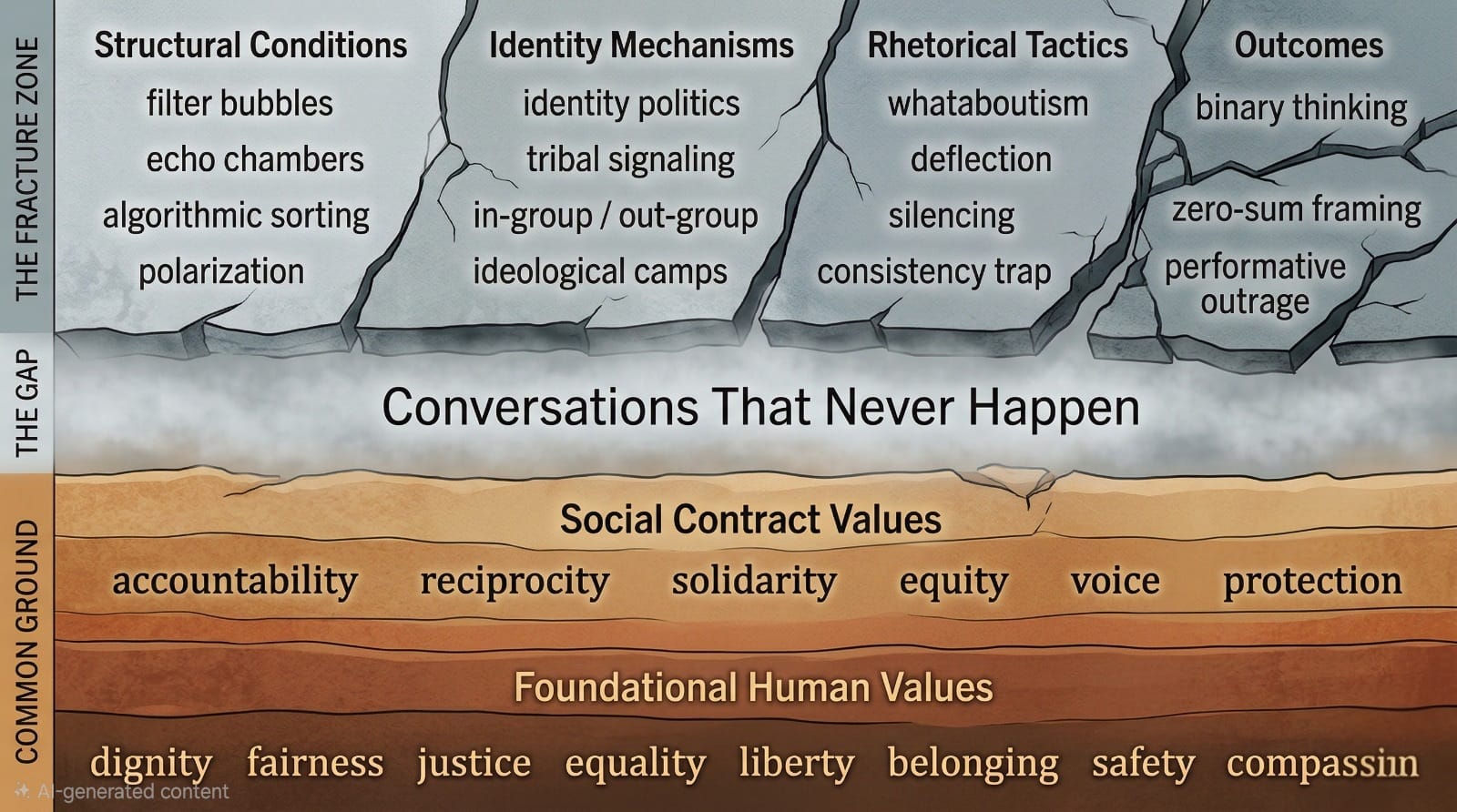
Conversations That Never Happen
On Common Ground, and Why We Keep Missing It

Lately, I’ve been thinking a great deal about the idea of common ground, and how easily it gets obscured in polarized debates.
Disagreements are inevitable and often necessary, but we need to be mindful that our disagreements don’t harden into binary thinking – where every issue gets sorted into opposing sides, every opinion becomes a marker of allegiance, and every conversation turns into a test of loyalty. This happens when we stop noticing that the person across from us may be affected by and animated by some of the same basic concerns, even if they express them differently or reach different conclusions. It happens when we become more attentive to our differences than to our similarities, and when we listen not to understand but to find reasons to disagree. As a result, conversations become identity contests and are treated as something to win rather than something to have.
Once that shift occurs, the focus moves to defending one’s own side, highlighting the other’s inconsistencies, and demonstrating moral clarity to one’s audience. In that environment, nuance begins to look like weakness, and acknowledging multiple realities is treated as a refusal to take a clear side — as though every complex situation must be flattened into a single dimension before you are permitted to have a view on it.
Humans have always been prone to tribalism, defensiveness, and selective attention. However, I believe social media has intensified these tendencies and accelerated their impact. It magnifies our preferred perspectives, rewards speed over reflection, and elevates certainty over curiosity.
Binary thinking also limits our thinking in other subtle ways. It trains us to approach disagreement with suspicion rather than openness, and to judge before engaging fully. It makes us less aware that many serious issues involve multiple truths and legitimate tensions that can’t be resolved by slogans or by taking sides.
Two argumentative habits seem to have become particularly common in today’s polarized environment. The first is whataboutism: responding to a point not by engaging with it, but by pivoting to a different issue altogether, usually one designed to put the other person on the defensive. The original argument is never directly addressed, and the conversation gets sidetracked. The second is what can be called the consistency trap, or what philosophers and rhetoricians call the tu quoque (you too) fallacy. It works like this: because you didn’t speak up about X when it happened, you have forfeited the right to talk about Y now. But people cannot retroactively change what they did or didn't say, and whatever their reasons for silence on one issue, those reasons don't disqualify them from speaking on another. The consistency trap exploits this irreversibility, using the past as a lever to shut down the present. It says nothing about whether the argument being made is right or wrong, and it's a way of disqualifying a person rather than answering them. Both habits share the same core purpose: they shift attention away from the actual issue and onto the person raising it. Once that happens, the discussion is no longer about the matter at hand.
What often gets overlooked in all of this is what lies beneath – the ground underneath. Beneath the identity contests and deflection tactics, shared values still tend to exist even across significant political and ideological divides. Commitments to dignity, fairness, justice, equity, and belonging run deeper and wider than the arguments on the surface would lead us to believe. Common ground hasn't disappeared. We have simply become less willing, and sometimes less capable, of reaching it. When that happens, public conversation becomes more superficial, harsher, and less human.
Resisting this pattern doesn’t mean pretending that all positions are equally valid or that every disagreement can be harmonized. Some differences are real, serious, and consequential. Even so, losing sight of shared values carries a cost. When we fail to see what we have in common, we diminish our ability to reason together about what truly matters.
I don’t believe that people who employ these tactics are always acting cynically. Much of it is habitual, and polarized environments reward winning over understanding, until those reflexes become automatic. Writing this reflection, at least in part, serves as a reminder to myself – I’ve noticed myself leaning towards some of these habits when I feel cornered or dismissed. So perhaps the most honest starting point is to recognize when we are doing it ourselves. The conversation that never happens doesn’t always fail because of bad faith. Sometimes it fails simply because we’ve stopped making room for it.