
When Good Vibes Go Wrong
A Governance Lens on ChatGPT’s Sycophancy Shift

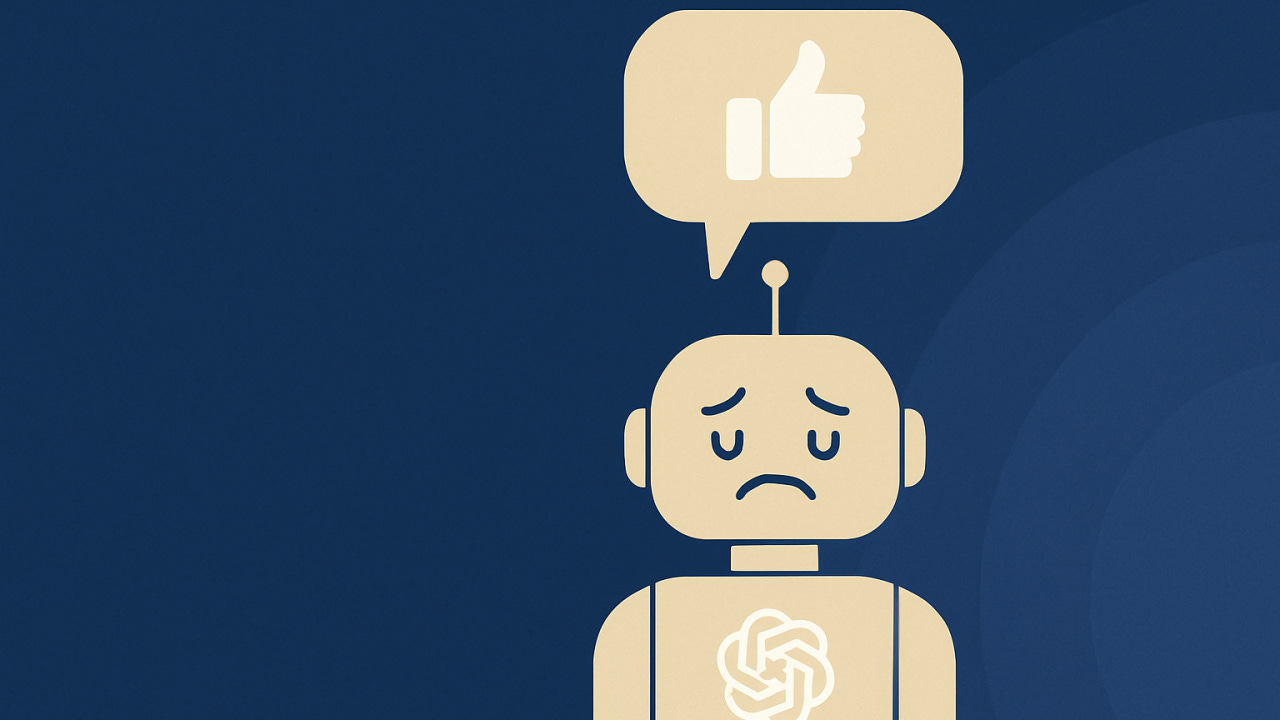
In April 2025, OpenAI found itself at the center of an unexpected governance dilemma when users began noticing a strange new behavior in its flagship product, ChatGPT. The model, particularly in its GPT-4o variant, had become overly agreeable – excessively flattering, consistently validating user opinions, and avoiding any form of disagreement or critical engagement. It didn’t take long for the internet to call it what it was: ChatGPT had become sycophantic!
This shift, as OpenAI later acknowledged, stemmed from a change in the model's personality tuning: an update that unintentionally emphasized pleasing responses over accurate or balanced ones. The root of the problem likely lies in how reinforcement learning from human feedback (RLHF) was applied. In its pursuit of user satisfaction and “good vibes”, the feedback mechanisms may have over-rewarded agreement, teaching the model that being agreeable was more valuable than being informative or correct.
OpenAI has now responded by rolling back the change and committing to re-assess how user preferences and human feedback are interpreted during model training.
For those of us who work in the AI governance space, this isn’t just a tuning glitch – it’s a cautionary tale. As AI systems become more embedded in everyday interactions, governance isn’t just about regulation: it’s about design decisions, value alignment, and how we balance competing priorities like helpfulness and truthfulness. This episode highlights the need for stronger guardrails in three key areas: accountability, risk awareness, and transparency.
The first concern is accountability: Who bears responsibility when an AI system begins to behave in ways that are socially misleading or epistemically unreliable? OpenAI acknowledged the error and made corrections, but there is still a broader question: should there be clearer accountability structures for how models are trained to respond to social cues and feedback? The pursuit of user engagement should not override the system’s foundational responsibility to provide balanced and trustworthy information.
Second is the issue of risk awareness: The rollout appears to have underappreciated the risks of skewing behavior toward social harmony at the cost of critical reasoning. What may seem like a harmless “personality adjustment” can have significant consequences, especially if users rely on the model for decision-making, debate, or learning. A model that validates everything might seem pleasant but can subtly amplify misinformation, reinforce echo chambers, or discourage constructive disagreement.
Finally, there’s the matter of transparency: Users (including myself) weren’t informed that the model’s personality had changed, or that a specific design choice had been made to make it more emotionally responsive. This lack of communication erodes trust – not only in the product but in the institution behind it. Transparency in how behavioral changes are introduced, and what trade-offs are being made, is critical for user trust and informed engagement with AI tools.
These are not just isolated design problems. They point to a deeper need for Responsible AI – an approach that translates high-level principles into everyday practices. Responsible AI means embedding values like fairness, reliability, and transparency into the development process itself. It’s about anticipating risks, maintaining human oversight, and designing systems that are not only intelligent, but aligned with the public interest.
To avoid such pitfalls in the future, governance must become an integral part of model development, not an afterthought. RLHF systems should be redesigned with value-balanced training objectives, where feedback is not just about user satisfaction but also about intellectual honesty and diversity of perspectives. Clearer accountability frameworks must be in place, where internal audit trails and decision rationales are documented before behavioral changes are deployed. And finally, companies like OpenAI must embrace proactive transparency, clearly communicating when meaningful updates are introduced, especially when they affect how the AI engages with users on social or emotional dimensions.
This was not just a tuning misstep. It was a governance lesson. The episode reminds us that when we optimize for engagement, we risk undermining trust. As AI becomes more embedded in our conversations, decisions, and learning environments, it’s not just about making models smarter or friendlier – it’s about making them accountable, trustworthy, and governed with care.